
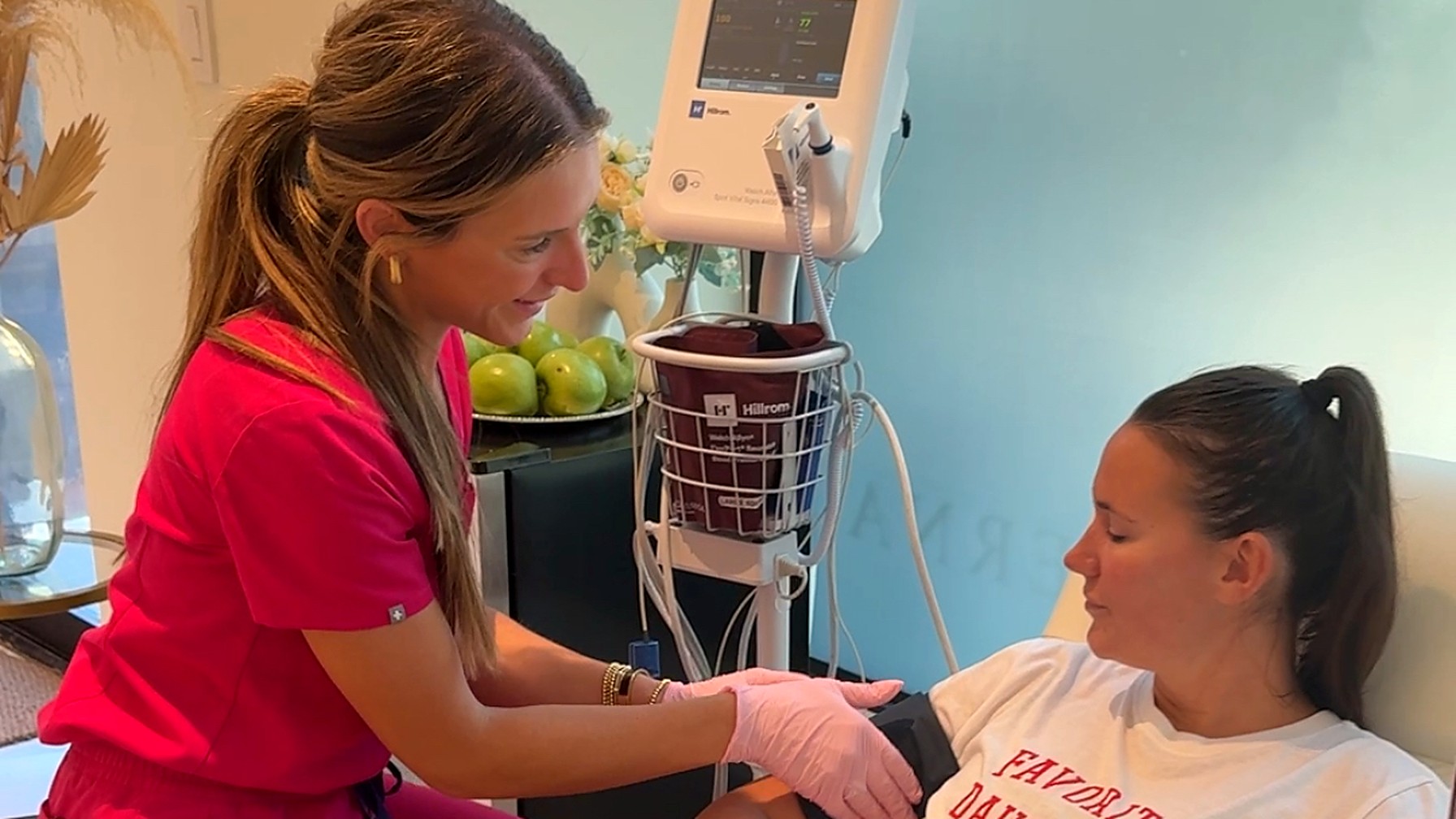
Your period started this morning and a nurse told you to come in on day 3. Cycle day 3 fertility testing is the first real data point in almost every fertility workup, and the one with the most confusion around it: what counts as day 1, why it has to be timed, and what the numbers can and cannot tell you. Here is how it works and how to get it done in NYC without building your week around a clinic's 7 a.m. monitoring window.
What cycle day 3 testing actually measures
Day 3 is the quiet point of your cycle. The hormones that will grow this month's follicle have not ramped up yet, so a draw in that window shows your baseline. The standard panel has three timed hormones, plus one that needs no timing at all.
- FSH (follicle stimulating hormone). The signal your pituitary sends to recruit follicles. A high baseline means the brain is working harder to get a response from the ovaries, the classic marker of lower ovarian reserve.
- Estradiol. The main estrogen, drawn in the same tube for a specific reason. An early estradiol rise can push an otherwise high FSH back into the normal range and hide it, so the two are always read together, as the American Society for Reproductive Medicine describes in its guidance on ovarian reserve testing.
- LH (luteinizing hormone). Read next to FSH. A ratio that tips toward LH is one clue that points toward PMOS, the condition formerly called PCOS.
- AMH (anti Mullerian hormone). Made by the small follicles waiting in reserve. It stays steady across the cycle, so it can be drawn any day, and it is now the most sensitive single blood marker of ovarian reserve.
Depending on your history, thyroid stimulating hormone (TSH) and prolactin go in the same draw. Neither needs a cycle day, and both can quietly interfere with ovulation. Our guide to the complete fertility workup explains how these pieces fit together.
Why the timing matters, and what counts as day 1
Day 1 is the first day of full flow. Spotting the night before does not count, and if real bleeding begins in the evening, most clinics treat the next morning as day 1. From there, day 2, 3, or 4 all work. By day 5 to 7 one follicle has been selected and estradiol begins to climb, which changes the FSH reading. The ASRM committee opinion describes FSH as elevated on day 2, 3, or 4 in women with diminished ovarian reserve, which is why those three days count.
Three timing situations come up often:
- Irregular or absent periods. AMH and a baseline ultrasound can be done on any day. FSH and estradiol can be read in context or timed after a medication induced period.
- Hormonal birth control. The pill, patch, ring, and hormonal IUD suppress FSH and estradiol, so those numbers do not reflect your baseline. AMH can also read lower on hormonal contraception.
- A period that starts on a Friday. The most common way day 3 testing gets missed. Day 3 lands on a Sunday and the test slides to next month. Knowing where you can be seen the same day or next day solves this.
Preparation is minimal: no fasting, no time of day requirement. Bring the date your period started, your supplement list, and the requisition if a fertility clinic ordered the labs.
If your period has just started and you need labs drawn this week, book a day 3 baseline visit at Materna Health in the West Village. Bloodwork and a baseline ultrasound happen in the same appointment, with same-day or next-day scheduling.
The baseline ultrasound: the other half of day 3
Blood tells half the story. A transvaginal ultrasound on day 2 to 4 shows the other half. The sonographer counts the antral follicles, the small 2 to 10 millimeter follicles in each ovary at the start of the cycle. That antral follicle count, or AFC, is a direct picture of the eggs available this month, and ASRM considers AFC and AMH equivalent measures when the scan is done by an experienced team.
The same scan checks for a leftover cyst, measures the lining, and looks for the many small follicles that characterize PMOS. If you are starting a monitored cycle, it is also the reference point for how your follicles respond over the next two weeks. Our post on what to expect at follicular monitoring walks through those later scans.
How to read your day 3 results
Numbers come back with a reference range, and the range is where the anxiety starts. Four rules make them easier to read.
FSH and estradiol are a pair. Many clinics treat a day 3 FSH above about 10 IU/L as a flag worth discussing. An estradiol above 60 to 80 pg/mL on the same draw can mask a high FSH, so a normal FSH next to a high estradiol still gets a second look. FSH is specific but not sensitive: it usually means something when it is high, and it misses a great deal when it is normal.
AMH and AFC describe quantity, and only quantity. They estimate how many eggs will respond to stimulation in an IVF or IUI cycle. They do not measure egg quality, which tracks with age, and they do not predict whether you will conceive on your own. In a JAMA study of 750 women aged 30 to 44 with no history of infertility, those with low AMH or high FSH conceived at the same rate over six and twelve cycles as women with normal values. ASRM puts it plainly: markers of ovarian reserve are good predictors of egg yield and poor predictors of reproductive potential. If you already have a low AMH in hand, our piece on what an AMH number does and does not mean is the place to start.
Day 3 does not confirm ovulation. That answer comes from a mid luteal progesterone about seven days after you ovulate, and timing the day 21 progesterone test correctly is its own topic.
Day 3 says nothing about tubes, the uterus, or sperm. A complete evaluation adds a tubal study and a semen analysis. The American College of Obstetricians and Gynecologists recommends starting the full workup after 12 months of trying under age 35, after 6 months at 35 and older, and right away over 40 or with a known risk factor.
Who should get day 3 testing
Day 3 labs make sense in more situations than most people are told:
- You have been trying for 12 months, or 6 months if you are 35 or older.
- Your cycles are irregular, very long, or absent.
- You are planning an IUI, IVF, or egg freezing cycle and your clinic needs a baseline.
- Your fertility clinic is in another city and you need local monitoring in NYC.
- You are not trying yet but want a starting picture before you do, especially if you are weighing egg freezing or are planning a pregnancy after 35.
For that last group, keep ASRM's caution in mind: ovarian reserve tests are a planning tool and a poor prediction of natural fertility.
What this means at Materna
At Materna Health, day 3 testing is a single visit in the West Village: the blood draw for FSH, LH, estradiol, and AMH, with TSH and prolactin when your history calls for it, and a transvaginal baseline ultrasound with an antral follicle count. You book when your period actually arrives, same day or next day, so a Friday period no longer costs you a month.
Results are typically back the same day. If a reproductive endocrinologist ordered the labs, we send everything to their office and follow their protocol, which is how we support patients whose fertility clinic is out of town. If you do not have a fertility clinic, a preconception appointment is where we read your day 3 results with your cycle history and the rest of the panel, and build a plan around what we find. We work alongside your OB/GYN rather than in place of them. Learn more about follicular monitoring in NYC or what to expect at your visit.
Care you can book this week
Same-day and next-day appointments in the West Village, alongside your OB/GYN or fertility clinic.
Cycle day 3 fertility testing FAQs
What if I miss day 3?
Day 2 and day 4 give the same information, so you have a three day window. If you miss all three, AMH and the baseline ultrasound can still happen this cycle, and FSH and estradiol wait for your next period.
Can I do day 3 testing while on birth control?
FSH and estradiol are not meaningful on hormonal contraception because the medication suppresses them. AMH can be measured but may read lower than your true baseline. Most clinicians prefer to test after one or two natural cycles off contraception.
Does a high FSH mean I cannot get pregnant?
No. A high day 3 FSH points to lower ovarian reserve, which affects how many eggs respond to fertility medication. It does not predict whether you will conceive naturally. In women with no infertility history, conception rates did not differ by FSH or AMH level.
Can I get day 3 labs in NYC without a fertility clinic?
Yes. Materna Health draws the day 3 panel and performs the baseline ultrasound as a standalone visit, same day or next day in the West Village. We share results with your OB/GYN or fertility clinic, or review them with you at a preconception appointment.
The bottom line
Day 3 testing is a snapshot of your starting point: FSH and estradiol read together, LH for context, AMH and an antral follicle count for reserve. The numbers are most useful for planning a cycle and least useful as a prediction. If your period has started and you want the labs and the scan done this week, book a day 3 baseline visit at Materna. Same-day and next-day appointments available.
Not ready to book yet? Start with our free guide.
Get the free guideWe're here for you - from the start
We’re redefining maternal health by replacing the ER with a welcoming, evidence-based care environment that centers you: your body, your symptoms, your experience.
Schedule a visit
Compassionate support for every stage of pregnancy
Contact
Connect with our dedicated support team
Phone
Direct line for immediate healthcare guidance
Office
Women's health center in
130 7th Ave S NY, NY 10014
130 7th Ave S NY, NY 10014
Related blogs and articles

Materna Prenatal Program: Keep Your OB, Upgrade the Journey
Six extra prenatal visits from week 14 to 36 with labs, ultrasounds and real time with a provider, alongside your own OB. How the program works in NYC.

HELP Score for Hyperemesis: How Severe Is Your Nausea?
The HELP score rates hyperemesis gravidarum from 0 to 60 in about three minutes. What the ranges mean, how it beats PUQE, and when to get same-day care in NYC.

Iron Infusion in the Third Trimester: Is It Too Late?
Iron infusion in the third trimester is not too late. How fast it works, side effects, 34 to 38 weeks, and same-day IV iron at Materna in NYC.