
Hyperemesis Gravidarum (HG) Treatment in NYC
In Manhattan

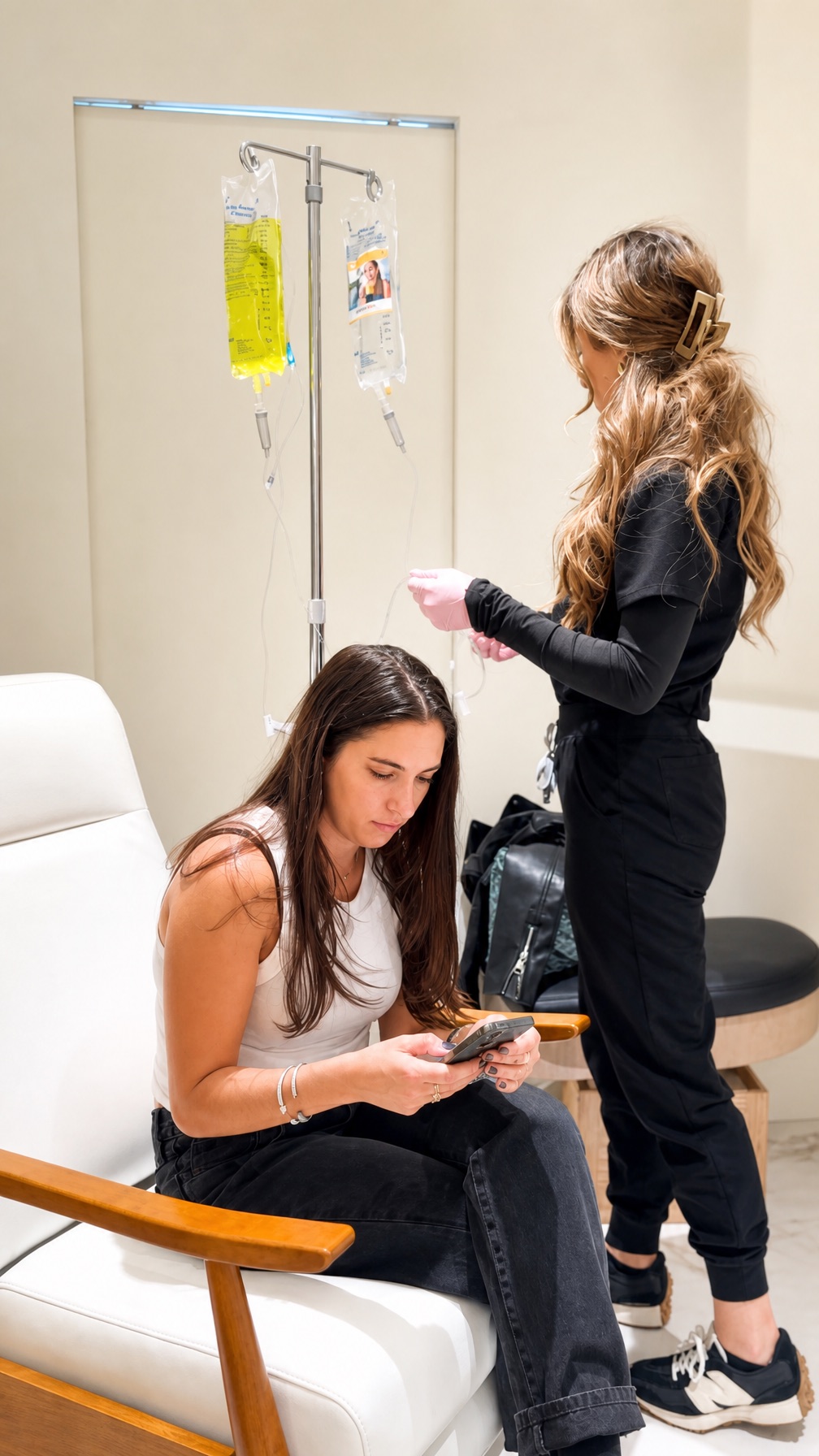
Hyperemesis gravidarum (HG) is treated the same day or next day at Materna Health's HG treatment center in the West Village. HG doctors and specialists run your labs and start IV fluids, anti-nausea medication, and thiamine in your first visit, then build a plan with you and your OB/GYN. No referral is needed, you do not have to be vomiting to be seen, and we treat any HG patient regardless of insurance coverage.
What an HG treatment visit looks like
You are seen by an OB/GYN provider, not triaged by a form. Assessment and treatment happen in the same appointment, and you go home with a written plan. Severity is scored with the HELP Score, the HER Foundation's validated tool, at every visit.
A HELP score, a physical assessment, a urine test, labs, and an ultrasound when your symptoms call for one. This tells us how dehydrated you are, how severe the HG is, and which step of treatment to start on.
IV fluids with electrolytes, thiamine (vitamin B1) before any dextrose-containing fluids, and anti-nausea medication through the same line. Most infusions take about 45 to 60 minutes in a reclining chair in our infusion suite.
Prescriptions, a written plan, and follow-up as often as you need it: some patients come in daily for a stretch, others once a week or once a month. Iron and nutrition support when little stays down. Your OB/GYN receives a summary of your treatment.
Care in-between OB/GYN visits.
Same-day and next-day appointments in New York City for the weeks between a positive test and your first OB visit · hyperemesis gravidarum · functional fertility

Medically reviewed by Dr. Robyn Glessner, DO, Medical Director, board-certified emergency room physician. Updated November 2026.
Give us two weeks
Most patients are below severe on the HELP score within two weeks of starting treatment, and some within days. We re-score you at every visit, because a falling score is objective evidence the plan is working and a stubborn one tells us to move up a step. If nausea is running your day, book today.
How we treat hyperemesis gravidarum, step by step
We follow the treatment ladder in the ACOG and Royal College guidance, starting with the safest options and stepping up as far as you need. With HG, most patients start several rungs up.
- Vitamins. Vitamin B6 (pyridoxine) is the base of every plan.
- Antihistamines. Doxylamine (Unisom), on its own or combined with vitamin B6 as Diclegis or Bonjesta.
- Anti-emetics. Prescription anti-nausea medication from a different class, such as ondansetron (Zofran), chosen with your history in mind. We talk through the safety data with you.
- IV fluids with vitamins. Fluids, electrolytes, thiamine, and anti-nausea medication through the same line, on a schedule that keeps you ahead of dehydration rather than chasing it.
- Nutrition and iron. HG depletes iron and nutrients fast. We check ferritin and offer iron infusions when stores are low, plus food and timing strategies for the days when little stays down.
If the plan is not working yet
We move up a step, or bring you in more often, when your HELP score is not falling, you are still losing weight, your medication is not staying down, or your labs show dehydration or low electrolytes. Confusion, vision changes, or trouble walking can signal thiamine deficiency, which is preventable and is treated the same day. HG responds to treatment. If a full HG plan is not bringing your score down, we look for a different cause, because nausea that does not respond to HG treatment is usually not HG.
Coming to us from the emergency room
Many of our patients find us after an ER visit or a hospital stay for HG, often with a bag of fluids and no plan for the next week. We take over from there: same-day visits, scheduled IV hydration, medication adjusted to your HELP score, and a summary to your OB/GYN. Across the more than 150 HG patients we have treated so far, none has needed a hospital admission.
HG doctors and specialists in New York City
Your care is led by Dr. Robyn Glessner, DO, Materna's Medical Director and a board-certified emergency room physician who has made hyperemesis gravidarum her specialty. She leads a team of HG specialists who treat severe pregnancy nausea every day: clinicians, registered nurses, and a sonographer, all in one West Village office. We work alongside your OB/GYN, keep them updated, and hand your care back whenever you are ready.
Meet Dr. Robyn Glessner, DOIf you had HG in a previous pregnancy
Prior HG is the strongest predictor of having it again. We see you at a preconception appointment, build the plan with the medications that worked for you last time, and start treatment while you are trying to conceive, so nausea is met at the first symptom instead of the first crisis.
Not sure it is HG yet?
Most pregnancy nausea is morning sickness, and we treat that too. Our morning sickness treatment in NYC page covers the milder end, our guide to HG symptoms and the HELP score shows where the line sits, and the HELP score takes about three minutes.
Insurance and cost
Yes, we are able to work with most commercial insurance plans. If we are out of your network, we also have self-pay pricing. We can treat any hyperemesis gravidarum patient regardless of insurance coverage. We accept HSA and FSA cards. Details are on our insurance and pricing page.
Hyperemesis gravidarum treatment FAQs
How soon can I be seen for HG in NYC?
The same day or next day. Book online, or call or text us, and we will get you in.
Do I need a referral?
No. You can book directly, and we send a summary of your treatment to your OB/GYN.
Do you give IV fluids in the office?
Yes. IV hydration with electrolytes, thiamine, and anti-nausea medication is given in our West Village infusion suite, usually in about 45 to 60 minutes.
What medications do you use for HG?
We follow the ACOG ladder: vitamin B6, doxylamine (Unisom, Diclegis, Bonjesta), and prescription anti-emetics such as ondansetron (Zofran), stepped up to the level you need and chosen with your history in mind.
How often will I need to come in?
As often as your symptoms need. Treatment is individualized: some patients come in daily for a stretch, others once a week or once a month.
Will you work with my OB/GYN?
Yes. Your OB stays your OB. We treat the HG, keep them updated, and hand your care back whenever you are ready.
I was just in the ER for HG. Can you take over?
Yes. Many of our patients come to us straight from an emergency room or hospital stay. We pick up the plan from there with same-day visits, scheduled IV fluids, and medication adjusted to your HELP score. Across the more than 150 HG patients we have treated so far, none has needed a hospital admission.
Book a same-day HG visit at Materna in the West Village. We work alongside your OB/GYN, and same-day appointments are available.
What Causes Nausea and Vomiting in Early Pregnancy?
Recent research has identified GDF15 (Growth Differentiation Factor 15) as a key biological driver of Hyperemesis Gravidarum (HG). During pregnancy, it is secreted by the placenta, and levels rise dramatically in early gestation. GDF15 interacts with a receptor in the hindbrain, the part of the brain responsible for regulating nausea and vomiting. Research suggests that women who experienced HG in previous pregnancies may experience worsening in future pregnancies. Symptoms can start as early as week 4 and may worsen between weeks 8 and 11.
It’s thought that nausea and vomiting in early pregnancy are caused by hormonal changes, such as higher levels of estrogen and human chorionic gonadotropin (hCG). In most women, nausea and vomiting begin at around 5-6 weeks but can become worse at weeks 8-11. HG may start earlier.
Morning sickness can actually occur at any time of the day. Certain risk factors can make it more likely, such as:
- Fatigue
- Stress
- A history of migraines or motion sickness
- Carrying twins or more
- Sensitivity to certain foods and smells
- Hormonal sensitivity
Morning sickness can become hyperemesis gravidarum (HG) when it leads to significant weight loss and dehydration because of challenges with eating and drinking.
Hyperemesis gravidarum treatment in NYC: what care at Materna looks likeNot sure it is HG yet? See our morning sickness treatment in NYC pageGet Early Pregnancy Support with Materna
Call or text to book a free, 15-minute consultation with our team. At Materna, we specialize in supporting women through the earliest and most important weeks of pregnancy.
OB/GYN care for the moments when you need answers now.
Here’s what we can do for you
Materna provides timely, evidence-based OB/GYN care during the critical periods between traditional visits. We offer same-week access to OB/GYNs who can evaluate symptoms, perform early ultrasounds, order labs, treat nausea and hyperemesis, support fertility and hormone concerns, and answer pressing questions with clarity and clinical expertise.

We're here for you - from the start
We’re redefining maternal health by replacing the ER with a welcoming, evidence-based care environment that centers you: your body, your symptoms, your experience.
Schedule a visit
Contact
Phone
Office
130 7th Ave S NY, NY 10014
YOUR HEALTH, YOUR WAY
Compassionate Care tailored to every stage of reproduction
At our practice, we combine advanced medical expertise with a deeply personal approach, ensuring every woman feels respected, supported, and heard at every visit.

You Have Questions.
We have Answers.
FREQUENTLY ASKED QUESTIONS
We provide a comprehensive range of OB/GYN services, including routine prenatal and gynecologic care, GYN and OB ultrasounds, annual wellness exams, Hyperemesis Gravidarum Treatments, IV Migraine Treatments and IV therapy for several conditions. We also offer comprehensive fertility support, cycle monitoring, and follicular management.
You can easily book an appointment through our website by clicking the “Book Now” button or by calling our office directly at (917) 938-7745. If you prefer, you can contact us via email or our patient portal for assistance.
Yes, we work with several major commercial insurance plans. Our billing team can review your benefits and provide an estimate of any expected costs before your visit. Please note that an EOB (Explanation of Benefits) from your insurance company is not a bill. If you receive one and have questions, we're happy to help review it with you. We also offer self-pay options.
Please bring your insurance card, a valid ID, any medical records related to your health history, and a list of medications you’re currently taking. If this is a prenatal visit, it is also helpful to bring any relevant information about your pregnancy and any questions you may have.
Yes, our services are designed for women at all stages of life. We offer routine gynecologic exams, treatment for menstrual issues, menopause management, and more. We believe in providing care for women of all ages and life stages.
We provide fertility care, preconception care, prenatal care and postpartum care through the first year after birth. If you're in the early stages of pregnancy or planning to conceive, we encourage you to book a consultation with us to discuss your options and receive early prenatal care, ultrasounds and screenings.
For your annual wellness exam, it’s helpful to arrive with any questions or concerns you might have about your health, along with a list of any medications you’re taking. If you’re due for a Pap smear or other screenings, we’ll handle those during your appointment. Avoid douching or using vaginal products 24 hours before your exam to ensure the most accurate results.
You can contact your doctor directly through our secure patient portal, via email, or by calling our office during business hours. We strive to respond promptly to all questions and concerns. If something cannot wait, please call us right away.
Yes, we offer a variety of educational resources for new moms, including prenatal guides, postpartum care tips, and support for breastfeeding and postpartum recovery. We also have podcasts and blog articles to keep you informed and confident during this special time.